Workshop power · System design case study

Three-phase workshop power from a single-phase supply.

A Victron and Dyness system designed around workshop starting loads, future storage expansion and provision for reconfiguration.

System design by Thomas Howe, founder of Synapse Energy Solutions.

Existing supply
Single phase
Inverter arrangement
2 per phase
Nominal storage
40.96 kWh
Discuss your workshop supply
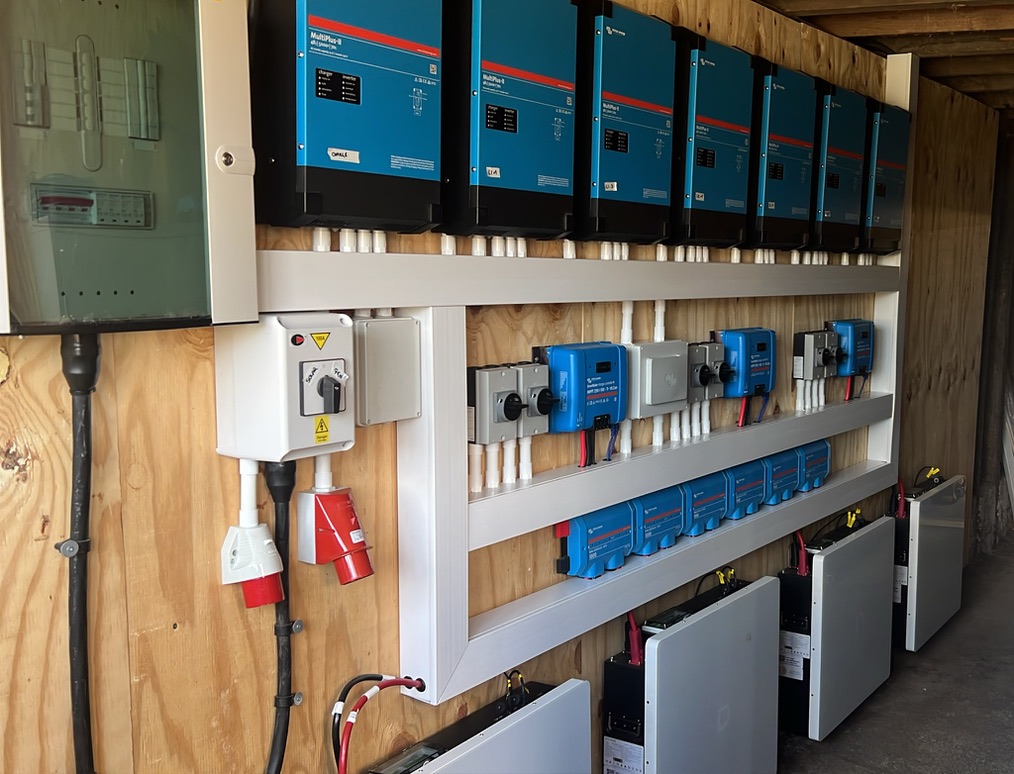
Seven Victron MultiPlus-II units, solar charge controllers, DC distribution and Dyness batteries in the workshop power installation
Six MultiPlus-II units provide the three-phase output, with a separate unit used for charging. System design by Thomas Howe.

The requirement

A three-phase workshop on a single-phase connection.

The customer needed three-phase power for a workshop, but the available electricity supply was single phase. Thomas designed a battery-based Victron system to provide the required three-phase output.

A dedicated MultiPlus-II from the 5 kVA range charges the battery system from the single-phase supply. Six further 5 kVA MultiPlus-II units form a separate three-phase inverter system, arranged as two units in parallel on each phase.

The six output units have a combined installed inverter rating of 30 kVA across the three phases, with 10 kVA per phase. The charging unit is additional to these six units; its charging output is governed by its charger rating and the system settings.

The kVA figures describe the inverter ratings. Available real power and starting capability also depend on the loads, temperature, battery system and operating settings.

Why two inverters per phase?

Designed around starting loads and service resilience.

The paired arrangement was selected to account for potential workshop start-up loads. The design also considered how the system could be reconfigured if an inverter developed an issue.

The arrangement provides options for restoring operation at reduced capacity after appropriate isolation, reconfiguration and checks by a competent installer. Recovery depends on the fault and the equipment remaining available, with a compatible configuration maintained across all three phases.

The battery system supports workshop demand when it exceeds the power being supplied by the charging unit. How long that can be sustained depends on the loads, battery charge and operating settings. The available charging power and the workshop’s energy use still need to be balanced over time.

Storage and future plans

40.96 kWh, with expansion planned.

Four Dyness Powerbox G2 lithium battery modules provide 10.24 kWh each, for a total nominal capacity of 40.96 kWh.

The customer intends to expand the battery storage in a later phase. Further storage can be considered as requirements develop, with the charging arrangements and system configuration reviewed alongside the proposed expansion.

The project demonstrates the value of considering the supply, workshop loads, inverter arrangement and battery capacity together at the design stage.

The designer

Victron experience applied to a specific problem.

Thomas Howe designed this system for the customer. His experience includes complex Victron power systems and training other installers on their use, supported by around 35 years in electrical work and more than 15 years in renewables.

SES provides independent design and consultancy for projects that need a tailored electrical solution, including workshops, constrained supplies and systems combining generation, storage and power conversion.

Explore electrical and power systems consultancy →

SES in practice

More Victron projects.

Explore a garden-workshop solar and storage installation and a property operating without a grid connection.

View all SES case studies →

Discuss your project

Need three-phase power for your workshop?

Tell SES about the available supply, equipment and starting loads. We can assess the options and develop a design around the site’s requirements.

Get in touch